
All advice / Planning and cost
What makes a heritage bathroom renovation different
An older home brings conditions a newer house does not. The wall framing may be hardwood. The drainage may be clay or cast iron. The floor may sit on timber rather than a slab. Lead pipe, old water lines or asbestos may turn up once the room is opened.
If the home is heritage-listed or in a heritage area, there are extra approval steps. The good news: most internal bathroom work does not need heritage consent. The real work is in the structure and the services, not the forms.
Heritage listing vs heritage conservation area
A heritage-listed home is on the NSW Heritage Register or a council list for its own value. A heritage area (HCA) protects the look of a whole street or block. The rules mainly cover changes you can see from outside.
For bathroom work, the split matters. A like-for-like internal fit-out — same footprint, same wet area, no walls moved — usually needs no heritage consent under either type. Changes to the outside of the building, to load-bearing walls or to heritage features inside may need a statement and council sign-off.
We check this at the on-site measure so the position is clear before the quote is written.
What you usually find behind the walls
Older Sydney homes share a pattern. The bathroom was often added or last done up decades ago. The pipes, drains and linings behind the walls are from that era.
Clay drains crack and sag. Old water pipes corrode and choke flow. Lead lines still turn up in some pre-1950s homes. Fibro sheeting, vinyl tiles and pipe lagging with asbestos are common in homes built before the mid-1980s.
None of this is unusual. A builder who works on older homes expects it. The key is that the quote allows for what is likely at strip-out, rather than treating it as a surprise. Our demolition guide covers what the strip-out process looks like step by step.
Structural and waterproofing considerations
A bathroom on a timber floor needs more prep before it can be sealed. The membrane cannot bridge movement in the subfloor. The base may need to be stiffened or re-sheeted first. This is normal on older homes but adds a step a slab bathroom does not need.
Wall framing in older homes is often uneven. Stud spacing, plumb and level can vary. The framing may need packing or new lining before tiles go on. This is prep work, not a defect — it is how these houses were built.
Every bathroom we renovate is waterproofed to AS 3740 and issued a compliance certificate, regardless of the age of the home.
Designing a bathroom that suits the house
A heritage home does not need a heritage-themed bathroom. What it needs is a bathroom that does not fight the character of the house. The proportions, ceiling height, natural light and architectural language of the home should influence the design — not dictate it.
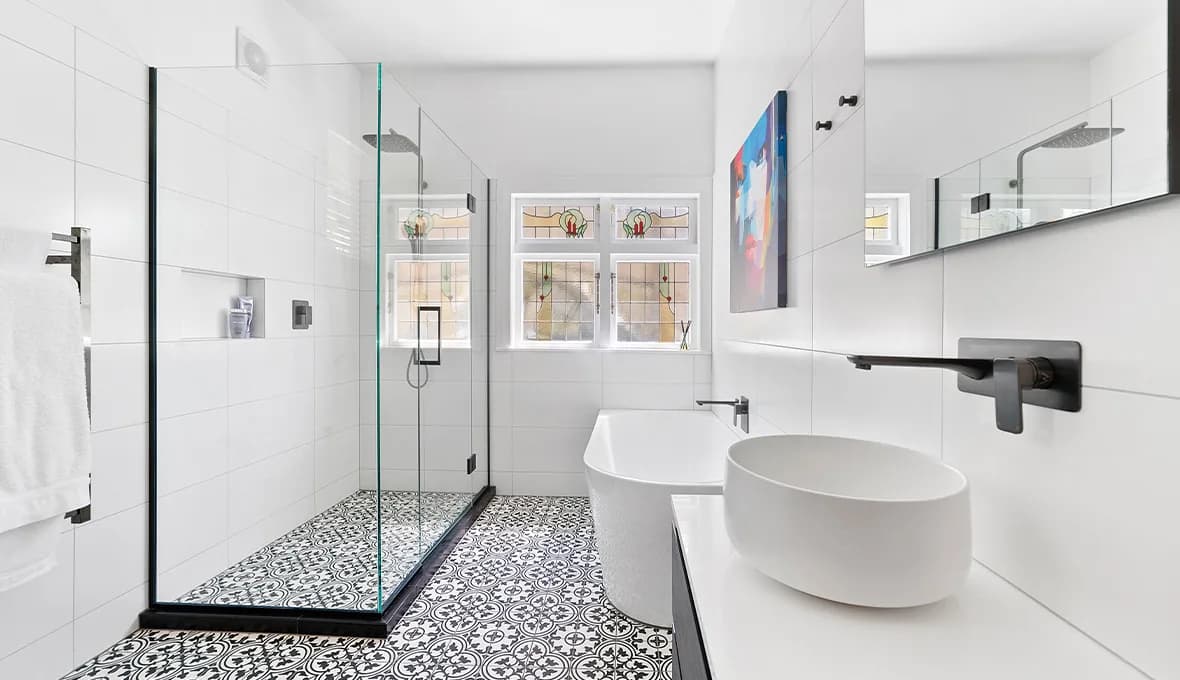
A freestanding bath, a frameless shower and modern fittings can work well in a terrace if the scale and palette suit the house. Our Rocks project shows this: large wall tiles, patterned floor tiles, matte black fittings and a freestanding bath sit around the original leadlight window.
Period-style fixtures are one approach, but not the only one. A clean, modern bathroom that suits the room often ages better than a mix of heritage copies.
Common design choices in older-home bathrooms
Subway tiles and hexagonal mosaics reference historical tile formats without committing to a full period reproduction. They work as well in a 1920s bungalow as in a contemporary apartment.
Freestanding baths suit rooms with higher ceilings and enough floor area. In a compact bathroom, a built-in bath or a walk-in shower makes better use of the space.
Timber vanities or vanities with a timber shelf bring warmth to a tiled room and suit the material palette of most older Sydney homes. Brushed brass and champagne gold fittings complement warm-toned timber and stone without looking out of place in a period home.
Cost considerations for older homes
A bathroom in an older home can cost more than the same scope in a newer house. The gap is almost always in the prep, not the finishes. Replacing old pipes, fixing a timber floor, removing asbestos and getting the base ready for tiles all add labour and time.
The best way to manage this is to allow for it from the start. A quote that assumes the best case behind the walls is a quote that will change at strip-out. We walk through what is likely at the on-site measure and price to match.
ETR's packages start from $18,000 for a Basic renovation in a small bathroom. Older homes more commonly fall into the Standard (from $25,000) or Premium (from $30,000) range because of the preparation work involved.
How ETR handles older and heritage homes
The on-site measure covers the approval position, what is likely behind the walls, and the design direction. The written quote names every item in the scope and how surprise finds at strip-out are handled — before work starts, not after.
Adam Dawood has over 25 years in tiling and project management. The team works on older Sydney homes regularly. The Rocks heritage bathroom, the Hunters Hill marble bathroom and the Artarmon bathroom-and-ensuite are all finished projects in older homes.
Every bathroom is waterproofed to AS 3740 with a compliance certificate, carried out under NSW Builder Licence 475204C, and covered by a 10-year workmanship warranty. A free on-site measure anywhere in Sydney is the starting point.
Frequently asked questions
Do I need council approval to renovate a bathroom in a heritage-listed home?
A like-for-like internal fit-out — same footprint, no walls moved, no changes to the outside — usually does not need heritage consent. Changes to the exterior or to heritage features inside may need approval. We check this at the on-site measure.
Does a heritage bathroom renovation cost more than a standard one?
It can. The gap is usually in the prep — replacing old pipes, fixing timber floors, removing asbestos and getting the base ready for tiles. The finishes cost the same. Allowing for this in the quote from the start avoids surprise extras.
Can I put a modern bathroom in a Federation or Victorian home?
Yes. A clean, modern bathroom that respects the room proportions and material palette of the house can work very well. A contemporary design does not have to fight the character of the home — our Rocks project combines large-format tiles, matte black fittings and a freestanding bath around an original heritage window.
What happens if asbestos is found during strip-out?
Asbestos-containing materials are common in homes built or renovated before the mid-1980s. Licensed removal is required and is a regulated process. The written quote sets out how unexpected finds like asbestos are handled before work starts.
Do you work on bathrooms in heritage conservation areas on the North Shore and Inner West?
Yes. We renovate bathrooms in heritage and Federation-era homes across Sydney, including the large heritage conservation areas in the Ku-ring-gai suburbs and the Inner West. Every bathroom is waterproofed to AS 3740 with a certificate, and the written quote accounts for the conditions typical of older housing stock.