
The short answer
Good bathroom lighting uses three layers, not one big fixture: task light for the mirror, ambient light for the whole room, and a softer accent layer for evenings.
Get those three layers right and the fixture count matters far less than where each light sits.
| Layer | What it does |
|---|---|
| TaskBeside or above the mirror | Even, shadow-free light for shaving, make-up and grooming |
| AmbientCeiling-mounted | General light so the room does not feel dim or flat |
| AccentNiches, shaving cabinets, toe-kicks | A softer mood layer for evening use |
Fixture positions and safety ratings still need to be confirmed against your room and wiring before anything is installed.
Start with the task
Good bathroom lighting solves everyday tasks first: shaving, grooming, applying makeup and cleaning. A room can feel nicer with layered lighting, but it still needs to be usable first.
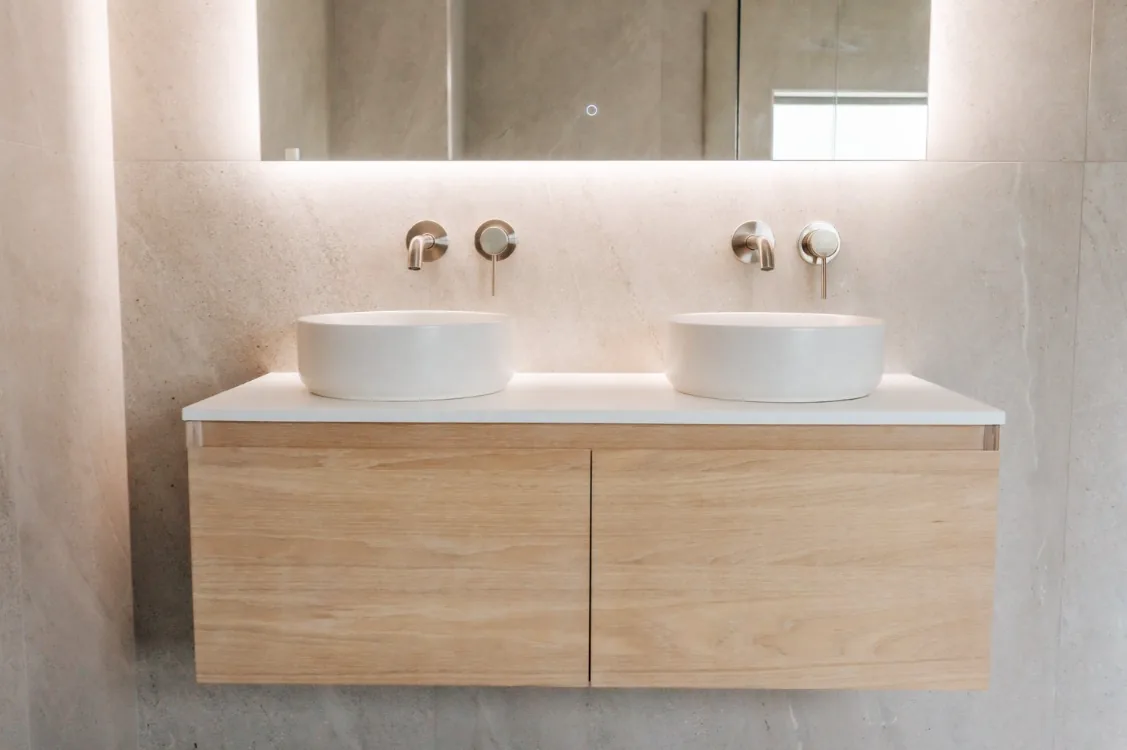
A single downlight above the door usually throws shadow across the face at the mirror. Light placed either side of the mirror, or built into a mirror itself, lights the face evenly instead.
Layer the light instead of relying on one fixture
Lighting works best in layers. A ceiling layer for general brightness, a task layer at the mirror, and a softer accent layer in a niche or shaving cabinet can work together without making the room feel busy or over-lit.
The right mix depends on the room size, mirror position and the finishes in the space. A small bathroom with light tiles needs less ambient light than a larger, darker-toned room.
Get the colour temperature right
Warm-to-neutral white light, roughly in the 2700K–3000K range, generally reads as calmer and more flattering to skin tones than a cooler, bluer white. A colder white can feel clinical in a small room.
Keep every fixture in the room on the same colour temperature. Mixing warm and cool white light in one bathroom is one of the most common reasons a finished room looks slightly wrong even when every fixture is good quality on its own.
Match fixtures to wet areas
Fittings near a shower or bath need a higher ingress-protection (IP) rating than fittings elsewhere in the room, because they need to tolerate moisture and spray. Australian wiring rules set out which zones near water need which rating.
This is a licensed electrician’s call, not a style choice. Confirm the required rating for each fitting’s position before you fall in love with a look that will not survive its own bathroom.
Plan lighting early, not last
Lighting positions get locked in once the electrical rough-in is done and the tiles are set. Deciding fixture types and positions during the early planning stage, alongside the waterproofing and tiling plan, avoids a mirror light that ends up in the wrong spot or a switch plate placed somewhere awkward.
Good lighting is not about adding more fixtures. It is about using the right light, at the right colour temperature and the right safety rating, in the right place.
Frequently asked questions
What is the best type of lighting for a small bathroom?
Layer it rather than relying on one ceiling fixture: a task light at the mirror, a general ambient light, and an optional soft accent light. A small room usually needs less total brightness than a large one, so avoid over-lighting it just because a bigger room next door has more fixtures.
What colour temperature should bathroom lights be?
Most bathrooms suit a warm-to-neutral white in the 2700K–3000K range, which flatters skin tones and feels calmer than a cooler white. Keep every fixture in the room at the same colour temperature so nothing looks mismatched.
Can I choose my own bathroom light fittings?
Yes for the style and finish. The placement and the safety rating near water still need to be confirmed against Australian wiring rules by a licensed electrician before installation.
Do LED mirrors count as a light source?
Yes. A built-in LED mirror can supply the task-lighting layer on its own, which is useful in a smaller bathroom where there is no room for separate wall lights either side of the mirror.
When should bathroom lighting be decided during a renovation?
Early, alongside the waterproofing and tiling plan. Fixture positions and wiring are locked in once the electrical rough-in and tiling are done, so deciding later usually means compromising on where the light actually falls.